
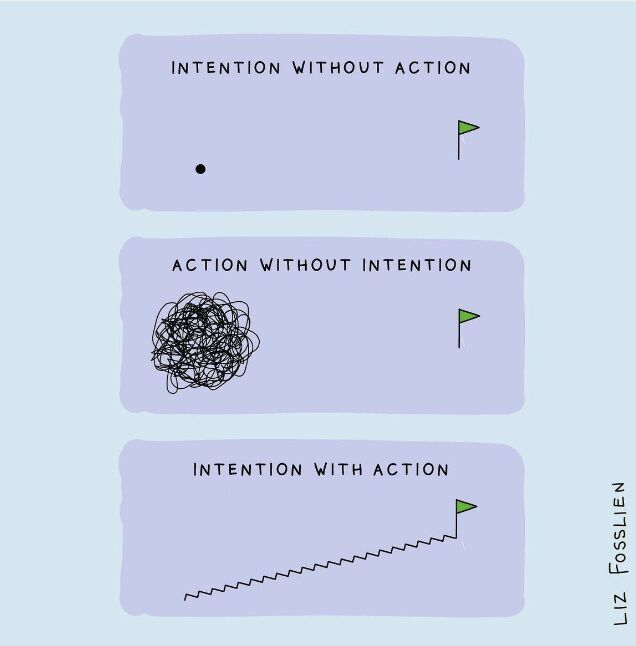
Intention and action do not always arrive at the same time. We often know what we want long before we do anything about it. We intend to change jobs, learn a new skill, become healthier, improve a relationship, start a project or finally deal with something we have postponed for months. The intention may be entirely genuine. We might think about it regularly, talk about it enthusiastically and even imagine what success would look like.
Yet nothing changes until intention meets action.
The opposite can be equally problematic. We can be extremely busy without being particularly clear about what all that activity is meant to achieve. Tasks are completed, emails answered, meetings attended and lists crossed off, but movement is not necessarily the same as progress. This relationship between intention and action is central to personal and career growth. Intention provides direction. Action creates movement. Either one without the other can leave us somewhere we never intended to be. The challenge is bringing them together.
Intention without action
Intention matters because almost every meaningful change begins with some conception of a different future. We decide that something should improve. Perhaps we want greater responsibility professionally, more time for family, a healthier routine or the confidence to pursue an opportunity we have previously avoided.
That intention can be powerful.
On its own, however, it changes very little.
There is a comfortable stage in which thinking about change can begin to feel remarkably similar to making change. We research possibilities, develop plans, discuss ideas and promise ourselves that we will begin when circumstances are better.
Monday.
Next month.
After the current project.
When work becomes quieter.
Once we feel more confident.
The difficulty is that ideal circumstances have an unfortunate tendency not to arrive.
Why good intentions remain intentions
Failure to act does not necessarily mean that the intention was insincere. Several things can stand between wanting something and doing something about it. Fear of failure is an obvious example. Taking action creates the possibility that our attempt will not succeed. An intention safely retained in our imagination cannot fail in quite the same way. Perfectionism can create another barrier. We convince ourselves that we need the complete plan before beginning, when the first step may actually reveal information that no amount of planning could provide. Sometimes the goal itself is simply too vague.
“I want to develop professionally” may express a genuine aspiration, but it provides little guidance about what to do tomorrow morning. A more useful question is:
What is the smallest meaningful action that would move this intention forward?
The answer might be sending an email, making an appointment, completing an application, spending thirty minutes learning something new or asking someone for advice. Progress does not always begin dramatically. Sometimes it begins with an action small enough that there is no longer a convincing reason not to take it.
Action without intention
Activity can create its own illusion of progress. A full diary feels productive. A completed task list provides satisfaction. Responding quickly to messages can create the impression that we are exceptionally effective.
But productive towards what?
Without intention, action can become reactive. The priorities of other people begin to determine how we spend our time. Urgent tasks displace important ones. We become increasingly efficient at doing things without asking whether those things deserve our attention in the first place. This matters professionally because organisations often reward visible activity. Meetings, messages, reports and rapid responses are easy to observe. Reflection is considerably less visible.
Yet a person can work extraordinarily hard while moving in the wrong direction.
Busyness is not the same as progress
The distinction between activity and progress requires us to ask what our actions are actually serving.
Why am I doing this?
Does this contribute to something that matters?
If I continue spending my time this way for the next year, where will it take me?
Those questions can be uncomfortable because they occasionally reveal that some of our routines exist primarily because they have become routines. This does not mean every action requires profound purpose. Much of life consists of ordinary tasks that simply need to be completed. Administration still exists. The washing still needs doing. Not every meeting can transform a career. The problem begins when activity consumes so much attention that we lose sight of direction.
Intention provides that direction.
When intention and action work together
The most productive relationship emerges when intention and action reinforce one another.
Intention answers:
Where am I trying to go, and why does it matter?
Action answers:
What am I going to do about it?
Neither question is sufficient alone.
This relationship is also more dynamic than a simple sequence in which we first decide exactly what we want and then execute a perfect plan. Action itself generates information. We begin something and discover that one assumption was wrong. An opportunity appears that we had not anticipated. A goal that seemed important six months ago becomes less relevant. Experience changes our understanding of what we actually want.
Action therefore feeds back into intention.
We act, observe, reflect and adjust. That is where personal development becomes less like following a fixed roadmap and more like navigation.
Turning intention and action into workable goals
Goals can provide the bridge between aspiration and behaviour, but only when they are useful.
The familiar SMART framework remains valuable here. Goals can become easier to act upon when they are:
- Specific
- Measurable
- Achievable
- Relevant
- Time-bound
However, the framework is a tool rather than a guarantee. A beautifully formulated SMART goal still achieves nothing if it remains untouched in a notebook. The more important step is translating the goal into behaviour. Suppose the intention is to develop professionally. That could become:
“I will complete a professional development course by the end of March.”
Better, but the next question remains:
What happens now?
Perhaps the immediate action is researching three suitable courses by Friday. The next might be discussing funding with a manager or registering for one of them. The larger goal provides direction. Smaller actions make movement possible.
Four practical ways to align intention and action
Different people need different systems, but several approaches can make the relationship between intention and action more visible.
1. Make the intention visible
A written intention is harder to ignore than one that exists only as a passing thought. A vision board can work for people who respond strongly to visual reminders. Others may prefer a written statement, notebook, digital document or a simple list kept somewhere visible. The format matters less than the function. It should remind you what you are trying to achieve and, more importantly, why.
2. Reduce goals to the next action
Large ambitions can become paralysing because they contain too many decisions.
“Change career” is enormous.
“Update the first section of my CV tonight” is actionable.
“Become healthier” is vague.
“Walk for thirty minutes after work on Monday, Wednesday and Friday” provides something concrete to do.
When a goal feels overwhelming, reduce it until the next action becomes obvious.
3. Review direction as well as progress
Progress reviews often ask:
“How much have I completed?”
Also ask:
“Is this still taking me where I want to go?”
There is little value in efficiently pursuing a goal that no longer matters. Changing direction is not necessarily failure. New information can legitimately change our intentions. Reflection allows action to remain connected to purpose rather than becoming automatic.
4. Create useful accountability
Another person can sometimes help close the gap between intention and action. This does not require elaborate accountability systems. Telling a colleague, friend, mentor or partner what you intend to do can create enough external commitment to make action more likely. The relationship should be supportive rather than punitive. Good accountability asks:
“You said this mattered to you. What happened?”
Sometimes the answer will be that circumstances changed. At other times, we may have to admit that we simply did not do what we said we would. Both answers provide useful information.
Keeping intention and action consistent
We often associate progress with motivation, but motivation is unreliable. Some days we feel exceptionally determined. On others, even relatively simple actions require considerable effort. If progress depends entirely on feeling motivated, intention and action will repeatedly drift apart. Consistency provides an alternative. This does not mean maintaining maximum effort every day. Sustainable progress often depends on accepting that the amount we can do varies.
On a productive day, we may make substantial progress. On a difficult day, the useful action may simply be maintaining continuity. Ten minutes of practice is still practice. One paragraph is still writing. One application is still an application. Small actions can appear insignificant when considered individually. Their importance becomes clearer when repeated. This cumulative effect is also central to the power of habits, where repeated behaviours can gradually shape personal and professional outcomes.
How intention and action shape professional growth
The relationship becomes particularly interesting in career development because professional life contains so many competing demands. We may intend to develop new skills while spending every available hour completing immediate work. We may want greater responsibility without taking opportunities that would demonstrate readiness for it. Perhaps we intend to build professional relationships but repeatedly postpone conversations because urgent tasks feel easier to justify. Career growth rarely occurs through intention alone. Yet indiscriminate action is not much better. Taking every opportunity, attending every event and accepting every additional responsibility can produce exhaustion without necessarily creating meaningful development. The relevant question is not:
“Am I doing enough?”
It is:
“Are the things I am doing aligned with where I want to go?”
That distinction can change how we think about professional development.
When intentions need to change
Persistence is often celebrated as an unquestionable virtue. Sometimes it is. Sometimes persistence simply keeps us committed to an intention that no longer deserves our commitment.
Goals can become outdated. Circumstances change. Priorities shift. We learn things about ourselves that we did not know when the original intention was formed.
Reflection therefore needs to accompany action. There is no virtue in continuing towards a destination simply because we once decided to go there. Changing an intention after careful reflection is different from abandoning it whenever progress becomes difficult. Distinguishing between the two requires judgement. Ask why the intention has changed.
Has the goal genuinely become less important?
Has new information altered the situation?
Or has the work simply become uncomfortable?
The answer determines whether adaptation represents wisdom or avoidance.
Personal growth is rarely linear
The infographic accompanying this article captures the central relationship beautifully. Intention without action goes nowhere. Action without intention creates movement without meaningful direction. Intention combined with action produces progress. Real life, however, rarely produces the perfectly straight ascending line shown in a diagram. Progress pauses. Plans fail. Priorities compete. Circumstances interfere. Sometimes we move backwards before moving forwards again. That does not invalidate the relationship between intention and action. It makes reflection even more important.
The objective is not perfect execution. It is maintaining sufficient alignment between what matters to us and what we actually do.
Conclusion
Personal and career growth depend on more than knowing what we want. Intention and action need one another. Intention without action can leave meaningful ambitions permanently waiting for the right moment. Action without intention can create enormous amounts of activity without a clear sense of direction.
Bringing the two together does not require a perfect life plan. It requires clarity about what matters, enough action to create movement and sufficient reflection to notice when direction needs to change.
Set goals where they help. Break large ambitions into manageable actions. Build consistency rather than relying exclusively on motivation. Seek accountability when it is useful, and periodically question whether your actions still serve the intentions that originally gave them meaning.
Most importantly, begin.
A small deliberate action today is worth considerably more than a perfect intention indefinitely postponed. The relationship is simple:
Intention gives action direction. Action gives intention consequence. Reflection keeps the two connected.
That is where meaningful progress begins.
#IntentionAndAction #PersonalDevelopment #CareerGrowth #GoalSetting #ProfessionalDevelopment #SelfImprovement #SMARTGoals #ReflectivePractice #Productivity #PersonalGrowth
Acknowledgements
The infographic Action and Intention was designed by Liz Fosslien.