
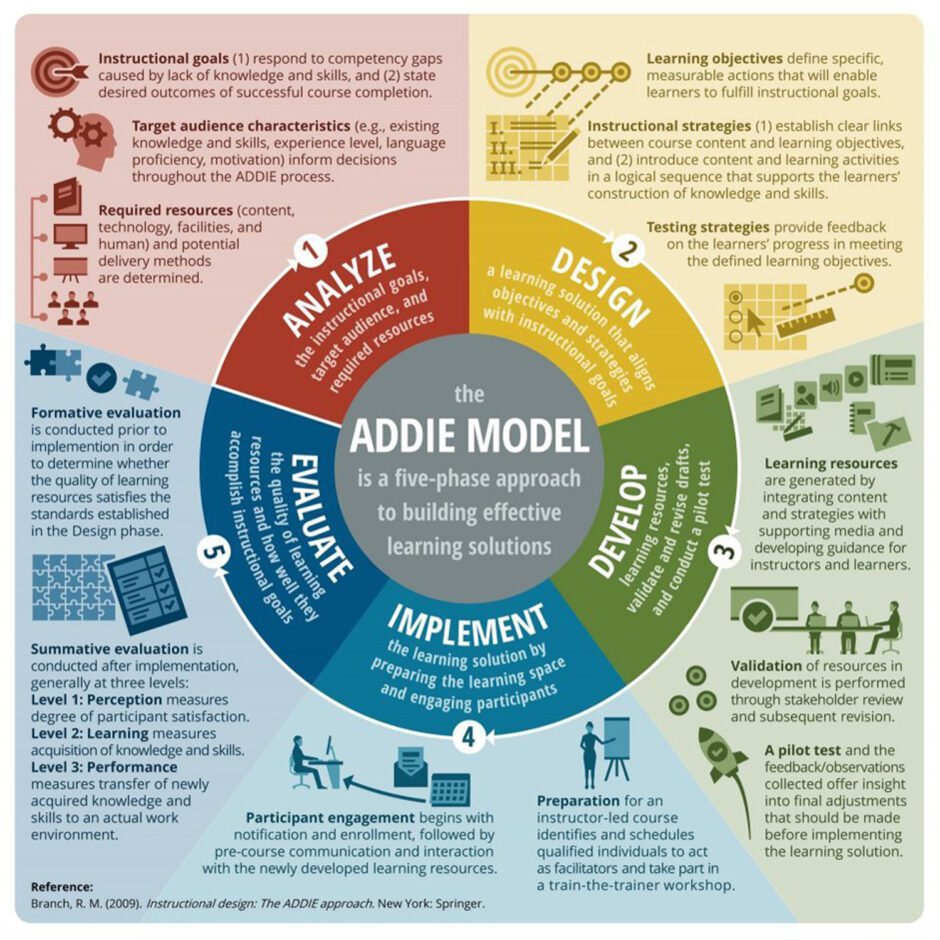
The ADDIE model offers a useful framework for something that can become complicated remarkably quickly: instructional design. Who are the learners? What should they know or be able to do? Which activities will help them get there? What resources are available? How will we know whether the learning has actually happened, and what should change when something does not work as intended?
The ADDIE model provides a deceptively simple way of bringing these questions into a coherent process. Its five phases, Analysis, Design, Development, Implementation and Evaluation, offer a structured framework for moving from an identified learning need to a designed, delivered and reviewed learning experience. What makes ADDIE particularly useful is not that it provides a rigid recipe. Quite the opposite. Its strength lies in its transferability. The same underlying questions can inform the design of a school lesson, a professional development programme, an online course or workplace training.
ADDIE gives us structure without requiring every learning experience to look the same.
Understanding the ADDIE model
The ADDIE model is commonly represented through five stages: Analysis considers what is needed, for whom and under what conditions; Design determines what the learning experience should achieve and how it should work; Development creates what is needed to make that design possible; Implementation brings the learning experience to its intended audience; and Evaluation asks whether it worked and what should change.
Presented like this, ADDIE can appear reassuringly linear. Analyse first, design second, develop third, implement fourth and evaluate at the end. In practice, however, instructional design is rarely quite so tidy. Problems discovered during development may require us to reconsider the design, while feedback during implementation can reveal something missed during analysis. Evaluation may then expose assumptions that send us back to the beginning.
This is one of the reasons I find the model useful. ADDIE provides a sequence for thinking without pretending that learning design always progresses neatly from A to B to C.
Analysis: understanding before designing
The Analysis phase begins before we create any materials because its purpose is to understand the problem we are actually trying to solve. Who are the learners? What do they already know? Which knowledge or abilities should they develop afterwards? What difficulties might prevent them from getting there? Which constraints involving time, technology, expertise and resources need consideration?
These questions sound obvious, yet skipping them can produce beautifully designed solutions to the wrong problem. Suppose students are struggling with a particular concept. The immediate temptation might be to create additional materials, but analysis could reveal that the problem is not a shortage of resources at all. Perhaps essential prior knowledge is missing. Maybe the instructions are unclear, the task requires vocabulary students have not yet acquired, or the assessment is measuring something different from what was taught.
The same principle applies outside schools. If employees are not following a particular procedure, training may appear to be the obvious response. Analysis might instead reveal unclear responsibilities, inaccessible information or a process that is unnecessarily difficult to follow. In each case, understanding the cause should precede designing the solution.
Why analysis makes ADDIE transferable
This is where the versatility of the ADDIE model becomes particularly visible. A primary classroom, university seminar and corporate training programme are very different environments, yet each requires us to understand the learners, objectives, context and constraints before designing an intervention.
Analysis prevents the framework from becoming generic. Instead of beginning with, “What should I create?”, we begin with, “What is actually needed?” That difference can save considerable time later and makes it less likely that design decisions will be based on assumptions rather than genuine requirements.
Design within the ADDIE model: turning needs into a learning experience
Once we understand the problem, the Design phase turns analysis into a plan. Here, learning objectives become more precise. We decide how learning will be structured, which activities are appropriate, how learners will engage with the material and how progress or achievement will be assessed.
The relationship between objectives, instruction and assessment is particularly important. If we want learners to analyse, evaluate or create, the learning experience needs to give them opportunities to practise those processes. An assessment that measures only factual recall would tell us relatively little about whether the intended higher-level learning occurred. Design therefore involves alignment between what we want learners to achieve, what they actually do during learning and how we determine whether they have achieved it.
It also involves choices. Should learners encounter an explanation before attempting a task? Would a worked example help? Does the subject require demonstration, discussion, practice, simulation or independent exploration? Should learning happen synchronously, asynchronously or through a combination of both? These decisions should follow from the learning objective, the content and the characteristics of the learners rather than from fashionable technologies or assumptions about fixed ‘learning styles‘.
Good instructional design does not ask how to make every activity equally appealing to everybody. It asks which methods best support the learning we actually want to achieve.
Development in the ADDIE model: creating learning resources
The Development phase is where the plan becomes tangible. During Development, instructional designers might produce slides, record videos and create or adapt worksheets, assessments, digital activities, simulations and supporting resources. This is often the most visible phase of instructional design because it produces the things people can actually see.
That visibility can also create a trap. It is easy to become absorbed in producing attractive resources and lose sight of why they exist. A beautifully designed presentation is not necessarily an effective learning resource, just as an interactive digital activity may be impressive without contributing much to the intended learning. Development should therefore remain anchored to the decisions made during analysis and design.
Technology should serve the design
Digital technology has dramatically expanded what can be developed. Learning can incorporate video, interactive exercises, collaborative documents, simulations, virtual environments, adaptive systems and increasingly sophisticated AI-supported tools. These possibilities can enrich learning considerably, but possibility is not purpose.
The relevant question is not, “What technology can I add?” It is, “What does the learning require, and can technology help me provide it?” Sometimes the best solution will be technologically sophisticated. Sometimes it will be a piece of paper and a well-designed question.
ADDIE accommodates both.
Implementation in the ADDIE model: where design meets reality
Implementation is the point at which the planned learning experience encounters actual learners, and that encounter matters because no design survives contact with reality entirely unchanged. Instructions that seemed perfectly clear during development may confuse learners. What was expected to be a twenty-minute activity might require forty. Technology can fail, learners may arrive with more or less prior knowledge than anticipated, and a discussion can reveal misconceptions nobody expected.
Implementation is therefore more than simply delivering completed materials. It requires observation and responsiveness. In a classroom, a teacher may adjust explanations, pacing or scaffolding while learning is taking place. In an online course, learner behaviour may reveal where navigation is unclear or where participants disengage. During professional training, questions from participants can expose gaps in the original analysis.
The design enters the real world during implementation. That is precisely why the next phase matters so much.
Evaluation within the ADDIE model: finding out what actually happened
Evaluation should not be treated as the final administrative task performed after everything important has finished. It is what allows us to determine whether our assumptions were correct. Did learners achieve the intended outcomes? Which parts of the experience supported them? Where did they struggle? Did the assessment provide useful evidence? Were the materials accessible and appropriate? Did implementation reveal problems that need to be addressed?
Evaluation can occur throughout the process. Formative evaluation provides information while something can still be changed. Designers can test a prototype, review instructions or trial an activity before full implementation. Summative evaluation, by contrast, considers outcomes after implementation and can help determine whether the programme achieved its objectives and what should happen next.
Both matter because evaluation is not simply about deciding whether something was “successful”. It provides information that can improve what happens next.
Evaluation closes the loop
Evaluation is also what prevents ADDIE from becoming a one-way production line. The information we gather feeds back into subsequent decisions. Perhaps the analysis missed an important learner need, the design included too much content, a resource requires revision, or implementation needs additional support.
Evaluation can therefore return us to any earlier phase. That feedback loop is essential because effective instructional design is rarely created perfectly on the first attempt. It develops through use, evidence and revision.
The ADDIE model is a framework, not a formula
One criticism sometimes directed at structured instructional design models is that they can become cumbersome or overly linear. That criticism is reasonable if ADDIE is interpreted rigidly. A large training programme may require extensive analysis, detailed documentation, prototypes, testing and formal evaluation. Designing a forty-minute classroom activity clearly does not require the same machinery.
The framework can scale. For a teacher planning tomorrow’s lesson, Analysis might involve thinking about what students understood today. Design could mean selecting an objective and deciding how students will practise it. Development might involve preparing one resource. Implementation happens in the lesson, while Evaluation occurs through observing students’ responses and reviewing their work afterwards.
The five underlying questions remain, but the bureaucracy does not have to. This scalability is one of ADDIE’s greatest strengths.
The ADDIE model across different learning contexts
Transferability becomes particularly useful when learning moves between contexts. The details change substantially, but the underlying process remains recognisable.
ADDIE in schools
Teachers can use ADDIE to connect learning objectives, classroom activities and assessment while responding to students’ prior knowledge and emerging needs. Its structure can support the design of an individual lesson, a sequence of lessons or a larger curriculum unit.
There is no need to label every stage formally for the thinking behind the model to be useful. Considering what learners already know before planning, aligning activities with objectives and reviewing evidence afterwards already reflects much of the logic underpinning ADDIE.
ADDIE in professional development
Training often needs to address a clearly identified gap while respecting limited time and existing expertise. Here, ADDIE encourages designers to establish whether training is genuinely required before developing it and to evaluate whether the resulting programme changes anything meaningful.
This is particularly important because training can easily become the default response to organisational problems that are not fundamentally learning problems. Careful analysis can reveal whether people need additional knowledge or skills, or whether the obstacle lies elsewhere.
ADDIE in online and blended learning
Digital environments make careful instructional design especially important because learners cannot always rely on immediate teacher intervention when something is unclear. Analysis can identify technological constraints and learner requirements. During the Design phase, instructional designers decide how learners will navigate and interact with the content, while Development produces the digital environment and resources.
Once learning begins, Implementation and Evaluation reveal how learners actually use what has been created. The medium changes considerably, but the underlying design questions remain remarkably stable.
Why iteration matters more than perfection
Perhaps the most useful way to approach the ADDIE model is not as five boxes to complete but as a disciplined cycle of questions. What is needed? What should we design? Which resources must we create? How will it work in practice? What did we learn from the result?
Then, where necessary, we begin again.
This matters because instructional design involves uncertainty. We make informed decisions, but we cannot know exactly how every learner will respond before implementation. Iteration allows the design to improve through evidence rather than assumption.
It also changes our relationship with mistakes. Identifying a problem during evaluation does not necessarily mean that the design process failed. Discovering what needs improvement is one of the purposes of evaluation. The real failure would be discovering it and changing nothing.
Conclusion
The enduring usefulness of the ADDIE model lies in its combination of structure and adaptability. Analysis encourages us to understand before designing. Design turns identified needs into a coherent learning plan. Development creates the resources that plan requires. Implementation brings the experience to learners, and Evaluation tells us what happened and what should change.
None of these phases guarantees effective learning by itself. Their value comes from the connections between them. Educators and instructional designers can apply the model to classrooms, professional development, online learning and workplace training because it does not prescribe a single teaching method or technology. Instead, it provides a sequence of questions that can be adapted to the context.
That transferability makes ADDIE particularly valuable in educational environments that continue to change. New technologies will emerge, learning environments will evolve, expectations will shift, and the tools available to educators and instructional designers will become more sophisticated. Yet the fundamental questions remain surprisingly durable:
Who are the learners? What do they need? What are we trying to achieve? How should we design for it? And how will we know whether it worked?
ADDIE does not answer those questions for us. It gives us a framework for answering them more deliberately, testing those answers in practice and returning to them when the evidence suggests that something should change.
#ADDIEModel #InstructionalDesign #LearningDesign #Education #TeachingAndLearning #EducationalResearch #ProfessionalDevelopment #OnlineLearning #Evaluation #ContinuousImprovement
Acknowledgements
The ADDIE Model Infographic featured in this article can be found on eLearning Infographics.