
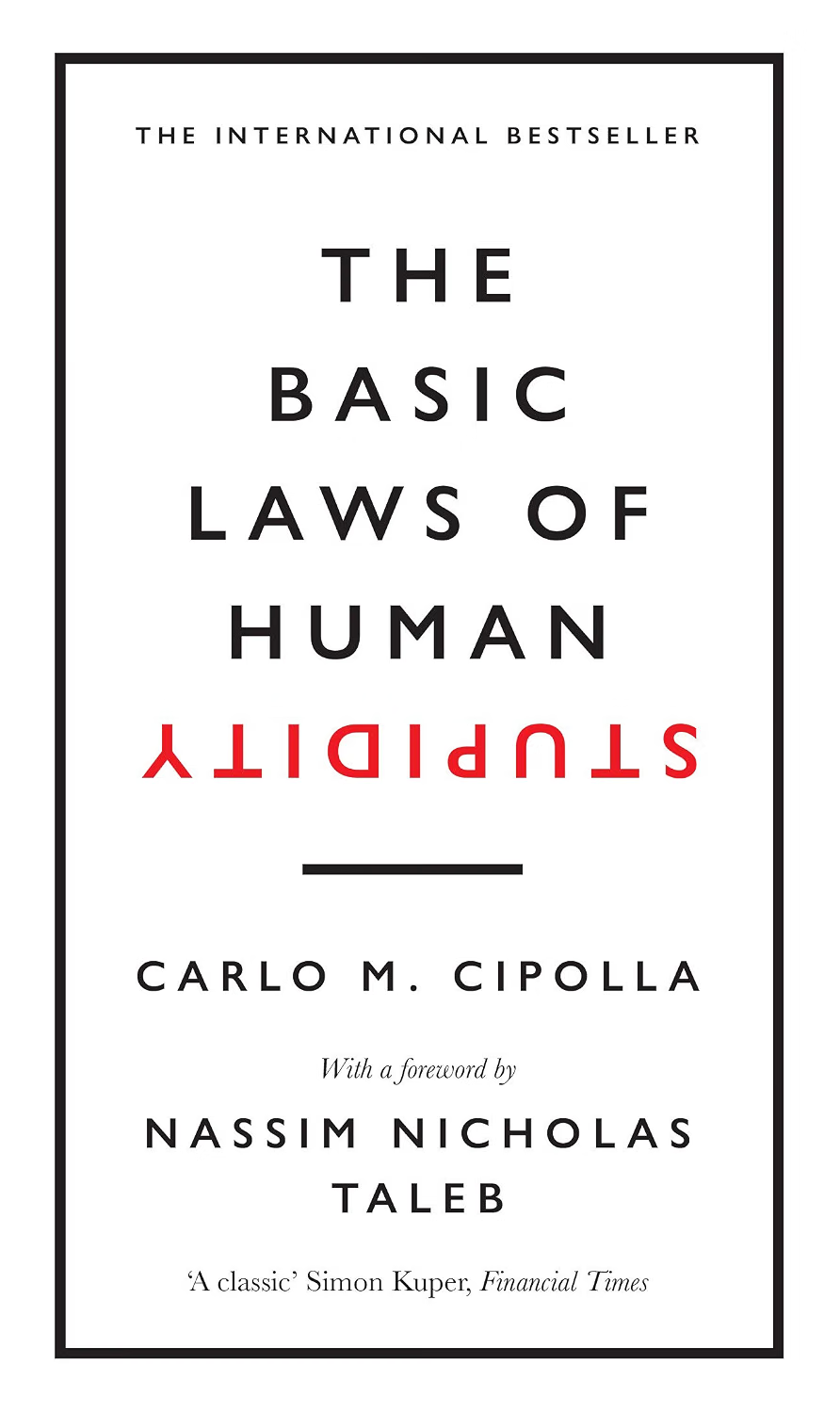
The basic laws of human stupidity may sound like an amusing subject for a book, but consider how often we encounter situations in which somebody makes a decision that causes unnecessary problems for everyone involved, including themselves. It might happen at work, in a family disagreement or in the way an organisation handles something that should have been straightforward. Sometimes the consequences are merely irritating. At other times, they can be remarkably serious.
What makes such behaviour particularly frustrating is that it often seems to serve no sensible purpose. Nobody benefits, yet everybody has to deal with the consequences. This is precisely the kind of human behaviour that Carlo M. Cipolla examines in The Basic Laws of Human Stupidity. Originally written in the 1970s, his short essay uses the language of economics to explain why stupidity may be more widespread, unpredictable and damaging than we care to admit.
The book is entertaining, occasionally uncomfortable and deliberately provocative. Beneath its humour, however, lies an interesting question: What happens when people make decisions that harm others without producing any meaningful benefit for themselves?
Understanding the basic laws of human stupidity
Cipolla approaches stupidity from an unusual perspective. Rather than associating it with intelligence, education or a lack of knowledge, he considers the consequences of human actions. His central argument is that stupidity cannot reliably be predicted from someone’s qualifications, professional position or apparent intellectual ability. Indeed, he suggests that people frequently underestimate both its prevalence and its potential consequences. This distinction matters. We often assume that education produces sound judgement, that professional experience leads to sensible decisions and that people in positions of authority possess the competence necessary to exercise their responsibilities.
Experience suggests that none of these assumptions is necessarily justified.
Cipolla develops his argument through five basic laws. Although presented with the apparent seriousness of an economic theory, they form part of a satirical examination of human behaviour rather than an empirically established scientific model.
The five basic laws of human stupidity
1. We consistently underestimate how much stupidity exists
The first law suggests that people routinely underestimate the number of individuals capable of behaving stupidly.
What makes this observation interesting is not simply its pessimism. It is the implication that our expectations are repeatedly challenged by experience. We encounter somebody who appears competent, knowledgeable or reliable, only to discover that their decisions produce consequences that seem entirely avoidable. We then reassure ourselves that the incident was exceptional, until something similar happens again.
Cipolla exaggerates this tendency for comic effect, but the underlying issue is recognisable. We often judge people by their qualifications, reputation or position rather than examining how they actually behave.
2. Stupidity is independent of other personal characteristics
The second law challenges the assumption that stupidity belongs primarily to people with limited education, intelligence or professional experience. According to Cipolla, it occurs across every social group, occupation and level of authority. This is perhaps one of the more uncomfortable aspects of the book. It suggests that academic achievement, professional status and social influence provide no automatic protection against poor judgement.
A highly qualified person may make decisions that are demonstrably harmful. Equally, somebody without formal qualifications may demonstrate excellent judgement, practical understanding and consideration for others. There is an important distinction here between possessing knowledge and applying it sensibly. Education can develop analytical abilities, but it does not guarantee sound decisions in every situation.
Cipolla’s law is deliberately sweeping, and there is no reason to treat it as a statistically demonstrated universal principle. Nevertheless, it invites us to question the confidence we place in titles, credentials and authority.
3. Stupidity causes harm without producing a corresponding benefit
The third law is the centrepiece of Cipolla’s argument. He defines stupidity in terms of an action that causes losses to others while providing no gain to the person responsible, who may even suffer losses themselves. This definition distinguishes stupidity from deliberate exploitation. Someone who knowingly harms another person to secure a personal advantage may be acting selfishly or dishonestly, but their behaviour still follows an identifiable logic.
Cipolla is interested in something different: decisions that produce harm without an apparent benefit to anyone. Consider a workplace in which a manager introduces an unnecessary administrative procedure. The new process consumes time, frustrates employees and delays important work, yet produces no measurable improvement. If the manager also suffers from the resulting inefficiency, the situation begins to resemble Cipolla’s model. Of course, real situations are rarely so straightforward. What appears pointless to one person may serve an objective that others do not recognise. An unpopular decision is not necessarily a stupid one. Nevertheless, the distinction between intended benefits and actual consequences provides a useful starting point for examining decisions.
The four categories of human behaviour
To explain the third law, Cipolla develops a simple model based on whether an action benefits or harms the person performing it and other people affected by it. He identifies four categories:
| Category | Consequences for the individual | Consequences for others |
|---|---|---|
| Intelligent | Benefits | Benefits |
| Helpless | Suffers a loss | Benefits |
| Bandit | Benefits | Suffers a loss |
| Stupid | No benefit or a loss | Suffers a loss |
The model is memorable because it shifts attention away from personal characteristics towards outcomes. An intelligent action, in this framework, creates benefits for both the individual and others. A helpless action benefits somebody else at the expense of the person responsible. A bandit gains by imposing losses on others. A stupid action produces harm without a corresponding benefit to its originator. This is an intentionally simplified account of human behaviour. People have competing interests, and consequences may be difficult to measure. An action that appears harmful in the short term may produce benefits later. Individuals may also disagree about what constitutes a gain or loss.
Cipolla’s categories are therefore more useful as a device for examining behaviour than as permanent labels for individuals. They encourage a question that is often overlooked when evaluating decisions: Who actually benefits from what has happened, and who bears the cost?
4. We underestimate the damage caused by stupidity
The fourth law develops one of the most interesting implications of the third. People who generally behave rationally may assume that others will act according to recognisable interests. Even when someone behaves dishonestly, we can sometimes understand their motives and anticipate what they might do next.
Stupidity, as Cipolla defines it, is more difficult to anticipate because the behaviour does not necessarily produce a rational advantage for the person responsible. This unpredictability makes it dangerous.
In professional environments, for example, we may underestimate the damage caused by someone who repeatedly ignores evidence, refuses to acknowledge mistakes or introduces changes without considering their consequences. The problem becomes more serious when organisational structures allow such behaviour to continue without effective scrutiny. However, unpredictability alone does not establish stupidity. People may act on incomplete information, pursue objectives that are not immediately visible or respond to pressures that others do not understand.
The practical lesson is therefore not to assume that every irrational-looking decision reflects stupidity. It is to recognise the importance of examining consequences and establishing safeguards against avoidable harm.
5. Stupidity can be more dangerous than deliberate wrongdoing
Cipolla’s fifth law concludes that stupidity represents an especially dangerous form of human behaviour. His reasoning follows from the preceding laws. Someone who deliberately exploits others generally expects to gain something. That expectation may make their behaviour easier to understand, even when it is morally unacceptable.
Someone who causes harm without gaining anything may be less predictable. The argument becomes particularly relevant when we consider the consequences of decisions made by people who exercise authority over others. A poorly considered decision in an ordinary conversation may produce a misunderstanding. A similarly poor decision affecting an entire organisation can waste resources, damage professional relationships or create lasting difficulties.
The scale of the consequences depends not only on the quality of the decision but also on the power held by the person making it. This is where Cipolla’s satire begins to raise serious questions about leadership, accountability and institutional responsibility.
Why the basic laws of human stupidity matter beyond economics
Although Cipolla was an economic historian, the ideas in The Basic Laws of Human Stupidity extend well beyond economics. The book invites readers to examine situations in which people act against their own interests, disregard foreseeable consequences or create unnecessary difficulties for others. Such situations occur in families, workplaces, public institutions and everyday interactions.
One reason the book remains interesting is that it challenges the assumption that harmful behaviour must always have a clear motive. We tend to search for explanations. Perhaps somebody wanted to gain an advantage, protect their reputation or achieve a particular objective. Sometimes those explanations are correct. At other times, the consequences of a decision may be easier to identify than any convincing reason for making it.
Cipolla’s model offers a deliberately provocative way of considering this possibility. Yet there is a danger in applying it too enthusiastically. Once we begin classifying other people as stupid, we may become less willing to understand their circumstances, examine our own assumptions or acknowledge the limitations of our perspective.
The book is at its most useful when it encourages reflection rather than providing another vocabulary for dismissing people we dislike.
Human stupidity in the workplace
Professional environments offer countless opportunities to observe the difference between competence, authority and judgement. An organisation may employ highly qualified individuals, invest in sophisticated technology and establish elaborate procedures, yet still make decisions that undermine its own objectives. Sometimes this happens because information is incomplete. Sometimes competing interests prevent effective cooperation. At other times, organisational habits become so firmly established that nobody questions whether they remain useful.
Cipolla’s argument encourages us to look beyond the apparent professionalism of a decision and consider its actual consequences. Does a new procedure improve the work it is intended to support? Does a policy solve the problem it was introduced to address? Are those responsible willing to reconsider their decisions when evidence suggests that something is not working?
These questions are particularly relevant to leadership. Good leadership requires more than confidence and authority. It involves listening, recognising uncertainty, evaluating evidence and accepting responsibility for decisions. An organisation in which people cannot question poor decisions may unintentionally increase the damage those decisions cause. This is not necessarily because its leaders lack intelligence. Rather, the institutional conditions may discourage the very forms of reflection and accountability that help prevent avoidable mistakes.
Education, expertise and the limits of intelligence
As an educator, I find the distinction between intelligence and judgement particularly interesting. Education is frequently associated with acquiring knowledge, developing intellectual abilities and demonstrating competence through examinations and qualifications. These are important objectives, but they do not encompass every aspect of human decision-making.
A student may possess considerable factual knowledge yet struggle to evaluate the consequences of an action. An experienced professional may understand a complex subject while remaining unwilling to reconsider a mistaken assumption. Critical thinking requires more than access to information. It involves evaluating evidence, recognising alternative explanations and considering the implications of decisions. These abilities are closely connected to essential life skills such as self-awareness, communication and sound judgement.
Cipolla’s model is not a theory of learning, nor does it provide a framework for assessing intelligence. Nevertheless, it raises questions that educators and educational leaders may recognise. How do we encourage people to question their assumptions? How can institutions distinguish confidence from competence? And how do we create environments in which admitting an error is preferable to defending a decision that has already proved harmful? These questions extend beyond the classroom. They concern how individuals and organisations learn from experience.
The basic laws of human stupidity: strengths and limitations
The strength of The Basic Laws of Human Stupidity lies in its simplicity. Cipolla takes a familiar frustration and develops a model that makes readers reconsider the relationship between intentions, behaviour and consequences. His use of economic terminology gives the argument an appearance of analytical precision, while the humour exposes the absurdity of treating human behaviour as though it could be reduced to a handful of universal laws.
Yet that simplicity is also the principal limitation of the book. Human behaviour is influenced by circumstances, knowledge, incentives, emotions, social relationships and institutional pressures. Decisions that appear irrational from one perspective may become more understandable when additional information emerges. The distinction between intelligent and stupid actions also depends on how benefits and losses are defined. An individual may knowingly accept a personal disadvantage to help somebody else. In Cipolla’s simplified framework, this could resemble helpless behaviour, even when the action reflects generosity or a considered moral commitment. Likewise, a decision may produce an unfortunate outcome despite being reasonable when it was made.
There is a fundamental difference between evaluating the quality of a decision and judging it exclusively by its eventual consequences. For these reasons, Cipolla’s laws should not be mistaken for a validated psychological theory or a reliable method of classifying people. They work best as satire with analytical ambitions: a way of exposing questionable assumptions rather than establishing immutable truths about human nature.
About the author: Carlo M. Cipolla
Carlo M. Cipolla (1922–2000) was an Italian economic historian whose academic work examined economic development, population history and the relationship between societies and their material circumstances. He held a professorship at the University of California, Berkeley, and received international recognition for his contributions to economic history.
Among his distinctions were election as a Corresponding Fellow of the British Academy in 1989 and the International Balzan Prize for Economic History in 1995. Although his scholarly career was devoted to serious historical research, Cipolla also possessed a distinctive sense of humour. The Basic Laws of Human Stupidity demonstrates his ability to borrow the language of academic analysis and use it to examine the absurdities of everyday behaviour.
The essay originally circulated privately in English in 1976 and subsequently appeared in Italian as part of Allegro ma non troppo in 1988. Its later publication in English brought the work to a wider international readership.
Foreword by Nassim Nicholas Taleb
The edition discussed here includes a foreword by Nassim Nicholas Taleb, the author of The Black Swan and Antifragile. Taleb is known for his work on uncertainty, probability, risk and the limitations of human prediction.
His association with Cipolla’s book is particularly appropriate because the five laws repeatedly return to the dangers of underestimating behaviour that we do not fully understand or anticipate. Although their intellectual approaches differ, both writers challenge the confidence with which people sometimes claim to understand complex situations.
The foreword also places Cipolla’s satirical essay within a broader discussion about uncertainty and the consequences of mistaken assumptions.
Is The Basic Laws of Human Stupidity worth reading?
At just 96 pages, The Basic Laws of Human Stupidity is a relatively short book. Its argument is accessible, its structure is memorable and its humour makes an uncomfortable subject easier to examine. Readers looking for an empirically grounded psychological account of intelligence or decision-making will not find one here. Cipolla does not establish his laws through systematic research, and his categories cannot capture the full complexity of human behaviour.
That is not really the point of the book. Its appeal lies in the way it encourages readers to reconsider familiar experiences. We have all witnessed decisions that appeared unnecessarily damaging, encountered people whose confidence exceeded their judgement or struggled to understand why an avoidable problem was allowed to become worse.
Cipolla gives those experiences a framework that is both amusing and unsettling. I would recommend the book to readers interested in human behaviour, organisational life, leadership and the occasional absurdity of everyday interactions. It is especially interesting when approached with a willingness to question the model itself rather than simply applying its categories to other people.
Perhaps the most useful question is not whether we can identify stupidity in others, but whether we are equally willing to recognise it in our own decisions.
After all, the ability to notice poor judgement in somebody else does not necessarily make us immune to it ourselves.
Book information
Title: The Basic Laws of Human Stupidity: The International Bestseller
Author: Carlo M. Cipolla
Foreword: Nassim Nicholas Taleb
Publisher: WH Allen
Publication date: 24 October 2019
Format: Hardback
Language: English
Pages: 96
ISBN-10: 0753554836
ISBN-13: 9780753554838
Buy or explore the book: The Basic Laws of Human Stupidity on Amazon
Publisher information: Penguin Books
#TheBasicLawsOfHumanStupidity #CarloCipolla #NassimNicholasTaleb #HumanBehaviour #CriticalThinking #DecisionMaking #Leadership #BookReview