Seeing the world through Christopher Boone’s eyes
In this The Curious Incident of the Dog in the Night-Time review, I explore Mark Haddon’s unusual, funny and deeply affecting novel about Christopher Boone, a fifteen-year-old boy who sets out to discover who killed his neighbour’s dog. What begins as a relatively simple mystery soon develops into something considerably larger: a story about family, trust, independence and the difficulty of understanding a world that does not always make sense.
I found the book excellent. It is exciting, fast-moving and remarkably easy to read, yet there is much more beneath its apparent simplicity. Haddon places the reader inside Christopher’s distinctive way of thinking, allowing us to experience events according to his logic rather than constantly explaining him from the outside.
That is one of the novel’s greatest strengths. We do not simply observe Christopher. For 271 pages, we inhabit his world.
A murder mystery that becomes something much bigger
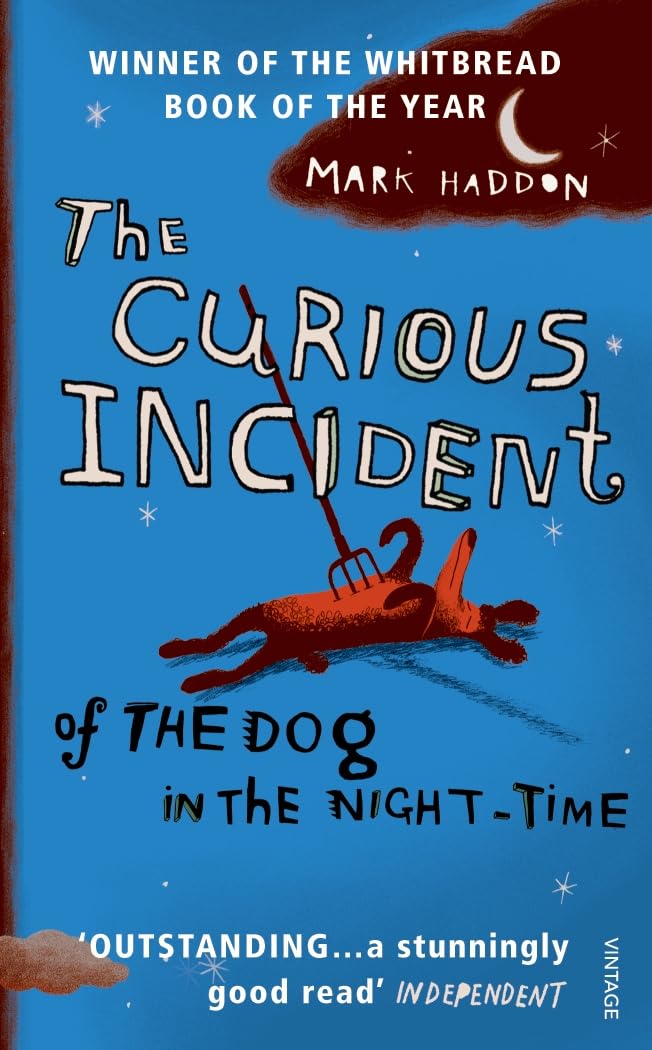
The novel begins with a striking image. Christopher discovers Wellington, his neighbour’s dog, dead in the garden, killed with a garden fork. Because Christopher values facts, logic and truth, he decides to investigate.
Christopher is an unlikely detective. He is exceptionally good at mathematics, notices patterns and details that others overlook, and approaches problems systematically. Human behaviour, however, is much more difficult for him. Metaphors confuse him, physical contact can be distressing, unfamiliar situations can become overwhelming, and people frequently behave in ways that appear irrational or dishonest.
The investigation gives the novel its initial momentum, but The Curious Incident of the Dog in the Night-Time is not really a conventional murder mystery. Wellington’s death is the catalyst for Christopher to begin asking questions. Those questions gradually expose truths much closer to home.
Haddon handles this transition particularly well. The mystery draws us into the story, but Christopher’s changing understanding of his family and his own ability to act independently ultimately becomes far more important than discovering who killed the dog.
I will avoid revealing the major developments because much of the pleasure of the novel comes from discovering them alongside Christopher.
Experiencing Christopher’s world from the inside
What impressed me most is the way Haddon constructs Christopher’s perspective. The novel is narrated entirely in the first person, and Christopher does not tell his story according to conventional literary expectations. He tells it according to his own.
Chapters are numbered using prime numbers. Mathematical problems, diagrams, maps, lists and observations interrupt the narrative. Christopher explains why certain colours bother him, why particular expressions make little sense and why knowing precisely what somebody means matters so much.
These features could easily have become gimmicks. Instead, they establish the logic of the novel.
The result is an unusual reading experience. Situations that another narrator might describe emotionally are sometimes presented by Christopher almost clinically. Yet precisely because he does not tell readers what they are supposed to feel, some of the book’s most emotional scenes become especially powerful.
There are moments when Christopher understands less about a situation than the reader does. We recognise the emotional implications of conversations or actions that he interprets differently. This creates both humour and sadness without requiring Haddon to manipulate the reader.
The Curious Incident review: humour, sadness and an accessible style
One of the things that became increasingly apparent while writing this The Curious Incident review is how successfully Haddon balances difficult family relationships, fear and emotional distress with a considerable amount of humour. Much of it emerges naturally from the difference between Christopher’s literal interpretation of events and the social conventions surrounding him.
I particularly enjoyed this balance. The Curious Incident of the Dog in the Night-Time can be genuinely funny without turning Christopher into the joke. At other points, it is sad and surprisingly moving.
Haddon’s writing is also imaginative without being unnecessarily difficult. The language is clear, the chapters are often short and the story moves rapidly. I found it extremely easy to become absorbed in the novel and read substantial sections without noticing how quickly I was progressing.
This also makes the English edition unusually approachable. Readers developing their English can follow much of the story without having to struggle through dense literary prose. That accessibility should not be mistaken for simplicity of thought. The language may be straightforward, but the questions behind it are not.
For this reason, I would not regard the novel merely as a book for younger readers. Adults can take a great deal from it, particularly from its treatment of communication, parenthood, trust and the assumptions we make about other people.
Autism, difference and the danger of easy labels
Christopher is widely described as autistic, and many descriptions of the novel have historically referred to Asperger’s syndrome. Yet it is worth being careful about reducing either Christopher or the novel to a diagnosis.
What makes the book effective for me is not a clinical label but the experience of entering Christopher’s thinking. Haddon creates a narrator whose perception of the world differs substantially from that of most people around him. The reader gradually learns his rules, fears, preferences and strategies.
That shift in perspective matters.
At first, Christopher’s behaviour may appear unusual because we instinctively interpret situations according to familiar social conventions. As the novel progresses, however, those conventions themselves begin to look less straightforward. Adults lie. People say things they do not literally mean. They conceal information, become angry, contradict themselves and expect others to interpret ambiguous language correctly.
From Christopher’s perspective, much of supposedly ordinary human behaviour is remarkably illogical.
This is where the novel becomes more interesting than a simple story about an autistic teenager. It asks readers to consider how much successful communication depends upon assumptions about what is “normal”, and what happens when two people understand the same situation through fundamentally different frameworks.
Truth, trust and family relationships
Truth is one of Christopher’s fundamental principles. He dislikes lies and values information that can be established logically. The adults around him live in a much less orderly moral world.
This creates one of the book’s strongest tensions.
Christopher’s investigation forces him to confront the fact that people he trusts have not always told him the truth. For someone whose sense of security depends heavily upon predictability, this is not a minor disappointment. It changes the structure through which he understands his world.
The novel is therefore also a story about damaged trust within a family. Haddon does not make these relationships comfortable or straightforward. Christopher’s parents have their own limitations, frustrations and failures. Their decisions sometimes hurt him profoundly, even when their motivations are more complicated than simple cruelty.
This prevents the novel from becoming sentimental. Love exists in Christopher’s family, but love does not automatically make people patient, truthful or capable of making the right decisions.
Independence and personal courage
Perhaps the most satisfying part of Christopher’s development is his increasing independence.
At the beginning of the novel, his world is geographically and socially restricted. Familiarity provides security. Travelling somewhere unknown, interacting with strangers or dealing with unpredictable situations can be extremely difficult.
Yet circumstances eventually require Christopher to move beyond those boundaries.
These sections are among the most compelling in the book because actions that might appear ordinary for another protagonist represent enormous challenges for Christopher. Haddon allows us to understand the effort involved because, by this stage, we have learned enough about Christopher’s world to appreciate what those actions cost him.
His achievements therefore feel earned rather than artificially inspirational.
The novel does not require Christopher to become somebody else in order to grow. His development comes from discovering what he can accomplish while remaining recognisably himself.
The Curious Incident of the Dog in the Night-Time review: why it remains worth reading
This The Curious Incident of the Dog in the Night-Time review reflects why the novel remains such an engaging read more than two decades after its original publication. Published in 2003, The Curious Incident of the Dog in the Night-Time became an international success, selling millions of copies and winning the Whitbread Book of the Year award. Its unusual narrator undoubtedly contributed to that success, but the book has more lasting qualities than its original premise might suggest.
It works simultaneously as a mystery, a family drama and a story about growing independence. It is accessible enough to read quickly but contains ideas that remain with the reader afterwards.
I would particularly recommend the English edition to readers who want to begin reading complete novels in English. The prose is manageable without feeling like simplified or artificial learner material. At the same time, experienced and adult readers will find plenty to consider beneath the accessible language.
It would also make an excellent gift because it does not depend on an interest in mathematics, autism or detective fiction. At its centre are much broader questions about how people understand one another and what happens when trust breaks down.
The Curious Incident of the Dog in the Night-Time review: final thoughts
Mark Haddon’s The Curious Incident of the Dog in the Night-Time is one of those books whose apparent simplicity conceals considerable depth. The initial mystery is compelling, the story moves rapidly and Christopher is an exceptionally memorable narrator.
I particularly appreciated the combination of humour and sadness. There are genuinely funny passages, but there are also moments that are uncomfortable and deeply moving. Most importantly, I came away feeling that I had spent the novel inside Christopher’s thinking rather than simply reading a story about him.
That distinction is crucial.
The book encourages us to consider another person’s perception of the world without constantly translating it into our own terms. Christopher’s logic, honesty, fears and determination shape everything we experience. By the end, seemingly ordinary achievements acquire a completely different significance because we understand what they mean to him.
As this The Curious Incident of the Dog in the Night-Time review shows, the novel combines an accessible story with surprisingly complex questions about communication, trust and independence. For me, that is what makes the novel so successful. It is entertaining and suspenseful enough to be read quickly, but thoughtful enough to remain in the mind afterwards. I can readily recommend it to younger and adult readers alike, including those reading a complete novel in English for the first time.
Purchase on Amazon: The Curious Incident of the Dog in the Night-Time
Publisher: Vintage
Published: 1st April 2004
Paperback: 271 pages
Language: English
ISBN-10: 0099470438
ISBN-13: 978-0099470434
#TheCuriousIncidentOfTheDogInTheNightTime #MarkHaddon #BookReview #ContemporaryFiction #EnglishLiterature #AutismInLiterature #Neurodiversity #ComingOfAge #ModernFiction #ReadingRecommendations