
Improving teaching and learning requires more than adopting new technologies or introducing innovative ideas. Advances in educational research, cognitive science and digital technology continue to create opportunities for schools. However, their value depends on how effectively educators translate these developments into classroom practice. Without a clear pedagogical purpose, even substantial investments in educational innovation may produce little meaningful improvement.
Eric Sheninger argues that educational change must begin with instructional design. Schools often invest considerable resources in new tools, programmes and professional development without first examining whether their existing teaching practices support effective learning. Consequently, the introduction of new technology can become an objective in itself rather than a means of improving educational outcomes. The underlying principle is straightforward: pedagogy should determine how technology is used, not the other way around.
To improve outcomes, we need to take a critical lens to instructional design.
Improving teaching and learning through instructional design
Transforming learning requires educators to examine and, where necessary, transform their teaching. This involves questioning established practices, identifying opportunities for improvement and evaluating whether changes benefit students. Rather than assuming that innovation automatically leads to progress, teachers and school leaders need to consider what happens in classrooms and how instructional decisions influence learning.
The following illustration provides a starting point for reflecting on classroom practice. Where would you position your own teaching, or the practices observed across your school? More importantly, which changes could improve students’ learning experiences?
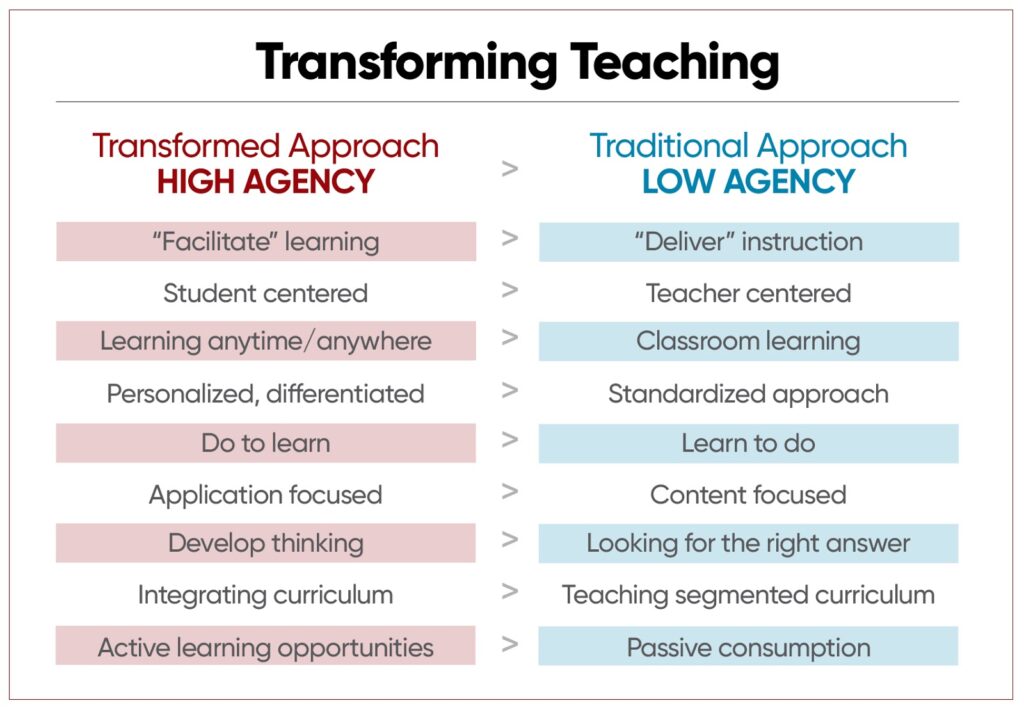
Such reflection should extend beyond the introduction of digital resources. A classroom equipped with sophisticated technology does not necessarily provide better instruction. Equally, effective teaching does not depend on having access to the latest digital tools. Instead, the more important questions concern the quality of the learning experience, the opportunities available to students and the evidence that they are making progress.
Measuring the return on instruction
Sheninger uses the concept of Return on Instruction (ROI) to emphasise the relationship between educational investment and improvements in learning. In their book Learning Transformed: 8 Keys to Designing Tomorrow’s Schools, Today, Eric Sheninger and Thomas C. Murray argue that educational innovation should demonstrate its value through improved teaching and student outcomes.
This principle applies not only to technology but also to professional development, curriculum initiatives and other forms of educational investment. Schools should therefore consider what changes as a result of their decisions rather than concentrating exclusively on the resources they acquire. For example, purchasing new digital devices may increase access to learning materials, but it does not necessarily improve students’ understanding or their ability to apply knowledge.
When integrating technology and innovative ideas, there needs to be a Return on Instruction (ROI) that results in evidence of improved student learning outcomes.
The concept shifts attention from expenditure to educational impact. Evidence might include improvements in student work, assessment outcomes, classroom participation or the application of knowledge. Nevertheless, evaluating instructional effectiveness also requires professional judgement, since not every meaningful learning outcome can be captured through standardised performance measures. A comprehensive evaluation should therefore combine appropriate evidence with an understanding of the educational context in which learning takes place.
Critical thinking and improving learning
Preparing students for an uncertain future requires opportunities to think critically, solve complex problems and apply knowledge in unfamiliar situations. However, learning should challenge students without making difficulty an objective in itself. Effective instruction provides appropriate support while encouraging learners to develop independence, confidence and a deeper understanding of the subjects they study.
Students also need opportunities to recognise why their learning matters. Authentic problems, interdisciplinary activities and practical applications can connect classroom knowledge with experiences beyond school. For instance, a project requiring students to investigate a local environmental issue may combine scientific reasoning, data analysis and communication skills. Such activities encourage learners to apply knowledge rather than simply reproduce information.
Importantly, these approaches do not necessarily demand extensive resources or complicated technological solutions. Teachers can often improve learning by reconsidering the questions they ask, the tasks they design and the feedback they provide. As a result, meaningful educational innovation may emerge from relatively modest changes to established classroom practices.
Five areas for improving classroom practice
Sheninger identifies five areas that educators can examine when evaluating instructional design. Together, they offer a practical framework for improving teaching and learning while encouraging reflection on the relationship between instructional decisions and student outcomes.
Designing meaningful learning experiences
1. Level of questioning
Do teachers ask questions that encourage analysis, evaluation and deeper understanding? Can students formulate their own questions and investigate possible answers? Rather than relying primarily on factual recall, effective questioning should provide opportunities for students to explain their reasoning and consider alternative perspectives.
2. Authentic and interdisciplinary contexts
Can students recognise connections between classroom learning and real-world situations? Do activities help them understand how knowledge applies beyond individual subjects? Such connections can strengthen the relevance of learning and encourage students to transfer their understanding to unfamiliar contexts.
3. Rigorous performance tasks
Can students apply their knowledge through meaningful activities? Do their completed tasks demonstrate conceptual understanding and progress towards learning objectives? For example, designing a solution, constructing an argument or producing an original piece of work can provide evidence of learning that extends beyond memorisation.
Assessing learning and providing feedback
4. Innovative assessment
Do assessment practices provide useful evidence of what students understand and where they need support? Could portfolios, projects or other approaches offer a more comprehensive picture of learning? Although traditional assessments remain valuable, alternative methods can reveal aspects of student development that conventional tests may not capture.
5. Improved feedback
Is feedback timely, specific and connected to clear learning goals? Does it help students understand their progress and identify what they should do next? Effective feedback should inform subsequent learning rather than merely communicate a grade or judgement.
Taken together, these five areas encourage educators to examine whether their instructional choices provide meaningful opportunities for learning. They also offer school leaders a basis for professional dialogue. Instead of concentrating exclusively on whether teachers use particular technologies or methods, discussions can address the educational purposes behind those choices and the evidence of their effectiveness.
Educational leadership for improving teaching and learning
Improving teaching and learning is not solely an individual teacher’s responsibility. School leadership influences professional development, institutional priorities and the conditions in which instructional change takes place. Consequently, leaders play an important role in establishing a professional culture that encourages critical reflection, collaboration and informed experimentation.
Effective leadership involves more than promoting innovation. It also requires an understanding of how organisational structures, available resources and professional expectations influence classroom practice. For example, teachers may recognise the value of collaborative planning or alternative assessment methods but lack sufficient opportunities to develop them. School leaders must therefore consider whether institutional arrangements support the improvements they expect teachers to achieve.
Sheninger’s argument also highlights the importance of accountability. Schools should be able to explain why they adopt particular strategies and how they evaluate their effectiveness. Nevertheless, accountability should support professional learning rather than reduce educational quality to a narrow set of performance indicators. Evidence becomes more useful when teachers and leaders interpret it in relation to their students, curriculum and educational objectives.
Putting pedagogy before technology
The central message is that meaningful educational change depends on the quality of teaching rather than the novelty of the tools available. Although technology can create valuable opportunities, its educational contribution depends on the purposes it serves and the conditions under which teachers and students use it. Neil Selwyn examines a related issue in his presentation on digital schooling, questioning whether technological innovation necessarily leads to meaningful educational change.
Improving teaching and learning therefore requires educators to align instructional decisions with research, professional experience and evidence of student progress. At the same time, schools must remain willing to question established practices and reconsider approaches that no longer meet their students’ needs.
Ultimately, educational improvement is not demonstrated by the number of innovations introduced but by the difference those innovations make to learning. By examining classroom practice critically, teachers and school leaders can identify where change is necessary and evaluate whether their efforts produce meaningful results.
Based on the work of Eric Sheninger
Author website: Eric Sheninger
Original publication date: 11 February 2018