
Why effective leadership begins with knowing what is within your influence
Leadership often involves acting in circumstances we cannot fully control. Focusing on the controllable can therefore provide a valuable anchor when decisions have unpredictable consequences, other people make their own choices, and even careful plans encounter events nobody anticipated. Yet leaders are not powerless. The distinction between what lies within our influence and what does not provides a useful way of thinking about leadership.
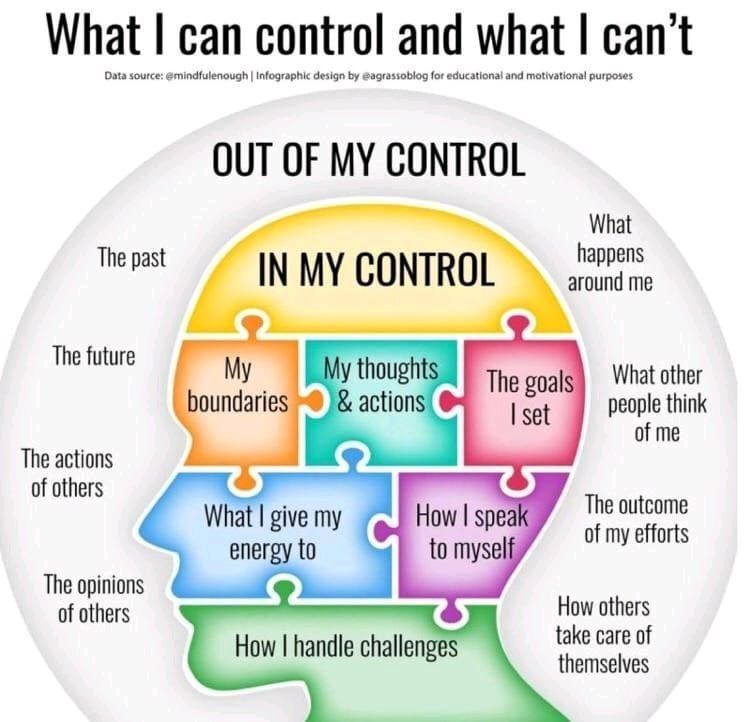
Inspired by an infographic created by Grassoblog (Antonio Grasso) under the theme #mindfulenough, this article explores the idea of focusing on the controllable. In particular, it considers where personal agency ends and uncertainty begins.
That distinction matters because leadership is not about controlling everything around us. Rather, it is about recognising where our attention, decisions and energy can actually make a difference.
Focusing on the controllable when reflecting on the past
The past occupies a curious position in discussions about control. We cannot change what happened, but we can control what we do with the experience. For leaders, previous successes and failures can therefore become valuable sources of information.
A difficult decision may reveal weaknesses in a process, while a successful project may expose practices worth repeating. Equally, an uncomfortable conversation may tell us something about our own communication. Reflection gives these experiences practical value because it turns hindsight into something we can use.
Instead of attempting to rewrite what has already happened, leaders can ask a more productive question:
What can I learn from it?
The event itself is beyond our control. What we take from it is not.
Focusing on what leaders can control
At the heart of focusing on the controllable are our own goals, boundaries and actions. Goals give direction, boundaries establish where our responsibilities lie, and actions translate intention into something tangible.
Our thoughts are more complicated. We cannot necessarily prevent every thought or emotional reaction from arising. However, we can consider how much attention we give them and how we choose to respond. This distinction is important because leadership begins with agency over one’s own behaviour.
A leader may want colleagues to change, circumstances to improve or difficulties to disappear. None of those outcomes is entirely theirs to command. Their own response, however, remains a much more productive place to begin.
Recognising what lies beyond our control
Other people’s thoughts, actions and opinions belong to them. This sounds obvious, yet considerable energy can be spent worrying about precisely these things.
Leaders can communicate clearly, establish expectations and attempt to influence behaviour. They can listen, persuade, challenge and support. Nevertheless, they cannot determine exactly how another person will think or respond. The same principle applies to events around us. Organisations change, priorities shift and unexpected problems emerge.
Recognising these limits is not an admission of helplessness. On the contrary, focusing on the controllable allows leaders to distinguish between circumstances they can influence and those they must learn to navigate.
There is an important difference between influence and control. Leadership gives us considerable scope for the former, but rarely guarantees the latter.
Focusing on what we can influence in an uncertain future
If the past presents lessons, the future presents possibilities. Planning is necessary, but certainty remains unavailable.
Leaders can establish objectives, anticipate risks and prepare alternative courses of action. Good planning improves preparedness, but it does not guarantee outcomes. For that reason, adaptability becomes particularly important when circumstances begin to change.
Rigid attachment to an original plan can sometimes become counterproductive. Instead, leaders need to recognise what has changed and decide whether their response should change with it.
Uncertainty therefore does not make planning pointless. Rather, it reminds us what planning is actually for: preparation, not prediction.
Focusing your energy on the controllable
Leaders retain considerable influence over how they communicate, where they direct their attention and how they approach challenges. How we speak matters, but so does what we choose to spend time thinking and worrying about.
Energy invested in a problem we can address may lead to action. By contrast, the same energy invested in something entirely outside our influence may simply produce frustration. Focusing on the controllable therefore involves making deliberate choices about where our attention is most useful.
This does not mean ignoring difficult realities or pretending that uncontrollable circumstances do not matter. Instead, it means asking a more constructive question:
What can I actually do about this?
Sometimes the answer will involve taking immediate action. At other times, it may require accepting that an outcome cannot be controlled and redirecting attention towards what can be done next.
Recognising what we cannot control
Perhaps one of the more difficult lessons of leadership is accepting that effort and outcome are not the same thing. A leader can prepare carefully, communicate effectively and make a well-reasoned decision, yet the result may still be disappointing.
Similarly, leaders can encourage colleagues to protect their well-being and create conditions that support healthy working practices. They can model appropriate boundaries, offer support and take concerns seriously. Ultimately, however, another person’s choices remain their own.
Recognising these boundaries does not absolve leaders of responsibility. Instead, it defines that responsibility more realistically. Leadership involves creating conditions, making decisions and exercising influence, but it does not confer control over every outcome.
This distinction can be difficult to accept, particularly when we care deeply about the result. Yet accepting the limits of our influence can also prevent us from carrying responsibility for things that were never entirely ours to control.
Focusing on the controllable in leadership
Understanding what we can and cannot control is ultimately an exercise in self-awareness. We can reflect on the past without becoming trapped by it, and we can prepare for the future without pretending to predict it. Likewise, we can influence others without assuming ownership of their thoughts, choices or reactions.
Most importantly, we can decide where to direct our own attention and energy. That does not remove uncertainty from leadership. Instead, it provides a way of operating constructively within it.
Perhaps this is one of the quieter disciplines of effective leadership: knowing when to act, when to adapt and when to accept. Focusing on the controllable does not make the unpredictable disappear. It simply helps us decide what to do when it inevitably arrives.
#LeadershipDevelopment #FocusingOnTheControllable #StrategicLeadership #ResilientLeadership #MindfulLeadership #SelfAwareness #AdaptiveLeadership #EffectiveCommunication #ReflectiveLeadership #ProfessionalDevelopment
Acknowledgements
The infographic that inspired this article was designed by Grassoblog (Antonio Grasso) as part of the #mindfulenough series.